Showing posts with label GM Skills. Show all posts

Task Resolution! What to handwave, and when to roll dice in your TTRPG

Last month I participated in "RPG Theory July" on Twitter. Each day, the TTRPG community had the chance to mull over some aspect of creating and playing RPGs.

One of the prompts for discussion was "Task Resolution," which is something that, it turns out, I have some pretty strong feelings about. I am surprised, in fact, to find that I'm able to articulate a coherent philosophy!

Caveat: Of course this won't appeal to everyone, it won't work at every table, and it won't fit all games.

But - if you are looking for a cinematic feel to your game, you want to skip over fiddly details, or you're just looking to use your time at the table as efficiently as possible, I think this'll be useful to you. Let's take a look!


Task Resolution & Narrative Focus

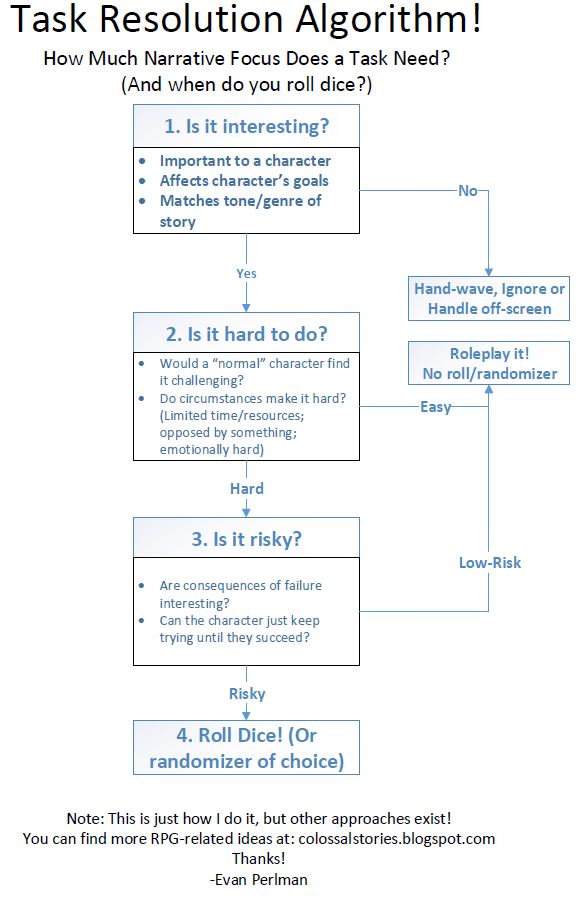
This algorithm is going to help you decide:
  • Whether a task to be resolved deserves narrative focus, and
  • How you should resolve the task's uncertain outcome.
What does this mean? I'm using Task Resolution to mean any situation where something is going to happen in your role-playing game, and the outcome is not certain. A character wants to shoot a monster, seduce a noble, or learn a difficult incantation. A monster wants to bite someone or run away. A thunderstorm produces lightning which might strike a character.

An RPG character walking across a room is not a task to be resolved - in most cases, it just happens. An RPG character running across a room and dodging a hail of bullets while doing so? THAT's a task to be resolved.

For purposes of this post I'm assuming that the game you're playing uses a randomizer to resolve uncertain task outcomes (most games use a dice roll; some use cards, or a Jenga tower, or something else). If your game resolves everything through player actions/discussion, or in general doesn't use a randomizer, then the end of the algorithm doesn't apply. You can still use the first few boxes to decide which things deserve narrative focus, though!

I'm using Narrative Focus to mean anything that you spend time talking about in the context of your story. So an out-of-character discussion about the rules, or a recap of previous events in the game, do not count as receiving narrative focus. Describing what your character does, or role-playing it, or bringing out props, or rolling dice to see what happens - all of these are narrative focus.


1. Is it interesting?

If it's not interesting, don't even spend time on it! But - what makes a task interesting?
  1. It's important to a character. Your characters are the windows through which players (and GMs) experience the fictional world of the game. If a task doesn't matter to them, it's not going to matter to the player, and it doesn't merit any narrative focus. 
  2. It affects the character's goals. This is an extension of it being important. The task being resolved has to have a measurable impact on something the character is trying to achieve. Obviously this has a pretty wide range, anything from "I want to make myself happy" to "I want to help my friend find his family" to "I need to do this to stay true to my principles." But if it doesn't affect the goal the character is trying to achieve, then character has no clear motivation to do it, and it doesn't merit narrative focus.
  3. It matches the tone and genre of the story. Think about the genre of story you're playing in. What kinds of actions and tasks would be considered important in those genres? ANY task can be worthy of narrative focus if it's important and relevant to the character, but if it doesn't fit in the mood of the fiction you can handle it off-screen, or skip it. For example, consider the task "get lunch." If the character is hungry enough, this could certainly meet the first two requirements, but in most genres we would skip it. But if the character is a noir detective living paycheck to paycheck, or a punk on the fringes of society in a barter economy, the simple act of procuring a meal becomes interesting because of the challenges and themes associated with it. 
If it's interesting, it deserves some narrative focus. And keeping the idea of challenges and themes in mind, we go on to the next decision!  We're going to spend time on it, in-game. Now the question is: do we resolve it via role-play? Or do we use the randomizing/decision-making mechanics?

2. Is it hard to do?

If it's not hard to do, we don't have to have a conversation about how to resolve the task, right? If it's easy, you just... do it. For example:

Player: "I do this easy thing, e.g.: walk across the room; talk to a guard; buy a drink; look up the capital of Burkina Faso on Wikipedia..."
GM: "OK. Great. You do it."

Of course, "hard to do" is relative. You have to calibrate it to the setting, genre, and to what's going on in the game at that moment. Heck, you can calibrate it to the character themselves - if they have a lot of skill in a certain kind of task, they should be able to "just do" much more challenging things with it than an untrained person would. Some systems (like Gumshoe) build this in deliberately, where a character automatically succeeds in an action of baseline-level difficulty once they're trained up beyond a certain point. 

But a lot of the difficulty is in the context. If the character is impaired, hassled, running low on resources, rushed, or opposed, something that would otherwise be a walk in the park can suddenly become difficult - and thus, something that needs to be resolved mechanically. 

Please note: even if it's easy, it can still be worthy of narrative focus! The distinction - and decision - being made in step 2 is about whether we need to use a task-resolution mechanic to resolve it. If it's easy but interesting, resolve the task through role-play. Describe what the characters do and how they resolve their task. Enjoy the storytelling. Then move on to the next interesting thing worthy of narrative focus.

3. Is it risky?

If the task is hard, it means the outcome is uncertain: the character might fail! If a task is risky, that means something bad happens if the character fails.  Like everything else, bad is relative to the context of the game and the scene. 
  • If failure means that the character just has to try again, this is not risky. 
  • If failure means that the character has wasted some time, this is not risky.
    • UNLESS the character is running out of time! If they are being pursued, or if wasting time means they'll lose an important opportunity, then suddenly failure does have consequences.
If it's not risky, it may still be worth role-playing the outcome, but the player and GM can decide together whether the character succeeds or fails - and since we've stipulated in these cases that failure is not that interesting, the character should succeed most of the time, right? 

If the task's outcome is uncertain and there are important consequences to failure, it's time to use a task resolution mechanic: roll dice, draw cards, whatever. Success means the character has accomplished something hard to do, in service of their goals. Failure means something bad has happened, and their goal slips farther away. 


4. Bonus Question: Does the system support this style?

I noted above that this algorithm won't work perfectly with every game, and I want to highlight one particular game where that's the case. In Call of Cthulhu (7th and earlier editions), characters increase their skill by succeeding at skill rolls. Therefore, the players have an incentive to seek out opportunities to roll. It's then up to the Keeper (the GM) to provide opportunities to roll dice. 

Does this mean that Call of Cthulhu games should be filled with a lot of meaningless dice rolls? No! But it does mean the Keeper - and scenario writers - need to hustle a little bit harder to make sure that the game is full of meaningful, risky tasks that fit the Investigators' skills. It's a challenge to be sure, but it's rewarding, and if the risks are high enough it really starts to make the Investigators sweat - and their players, too.

----------------------------------------------------------------------------------
Want more of what I do? I have a number of best-selling Adventures and GM guides for the 7th Sea system at this link, available via DriveThruRPG! If the link doesn't work right, go to drivethrurpg.com and search for me, "Evan Perlman."

Want to see how this algorithm can help spice up combat in your games? My Electrum Best-Selling GM guide "The Good Fight" talks specifically about creating a variety of interesting and meaningful consequences in 7th Sea combat. Never again will you have an endless slog against an improbably tough villain! Instead, players will get to enjoy the feeling of total and overwhelming panic as everything goes to hell all around them. Enjoy!

After-Action Report #2: Edge of Darkness

The Infamous Hobo with a Table Leg

A second-hand in-joke about "Edge of Darkness" was my first real introduction to an iconic Call of Cthulhu experience. About 10 years ago, I joined an established CoC group. I believe the first scenario I played with them was "The Haunting," like so many other players - but this group had already been through Edge of Darkness.

Our Investigators were starting to poke around Corbitt's house, prying into dark and unsettling corners, when one of the players joked: "Watch out for the hobo with a table leg."

"The what?" I asked.

"Last time, we walked into a basement without checking first, and a hobo with a table leg knocked our whole party unconscious."

(Image credit: Chaosium's Call of Cthulhu Starter Set, book 2, page 37. Note: the hobo in the Starter Set version of Edge of Darkness is not likely to be able to knock out a party. Maybe a previous version of the scenario was different... or maybe our Keeper just liked messing people up with hobos.) 


"A hobo...?"

"With a table leg," they solemnly confirmed. The need to check every dark room for furniture-wielding vagrants has stuck with me ever since.

Which is why I guess I was so disappointed in myself for letting my Investigators talk him down from his frenzy when I ran this scenario last week.

What went well this week...

My disappointment aside, this session really hummed. We got halfway through the scenario, and will finish up in early April. I'm going to detail my plan for that part at the end of this post, and if it merits a separate after-action post I'll put up a "#2a".

The first thing that went well was that I had a very clear idea of the details. I had a much easier time remembering how to describe each of the areas and NPCs the players interacted with. I realized that when I ran Dead Light I wasn't providing enough detail, and one of the challenges I had was in keeping track of the scenario information available to me as Keeper.

Most (all?) scenarios I've seen are written in a very narrative way. They will be organized with headings, but the paragraphs are often quite long. In the more thoughtfully-written scenarios, important terms are in bold, and there is some way to set apart likely [Skill Rolls] - often by using brackets. But I still found myself a little lost using the scenario-as-written "live" at the table.

So, for this week, I re-wrote Edge of Darkness into an outline format. The major headings were locations - it makes sense to me to organize people and plot points by the place where they can be found. Then, each type of encounter - NPC, bundle of clues, monster, set-piece, etc - had its own set of bullet points with things like:

  • Sense descriptions
  • Mannerisms (for NPCs)
  • Likely [Skill Rolls] and their results
  • Important clues that the Investigators would need to be nudged into finding if they missed all available versions of that clue
  • Name of handouts (and I also used symbols for the kind of handout: letter, physical object, song on my phone, etc)
  • I laid out details for the "Banishing Ritual" set-piece in a table format, with times noted next to the particular thing I wanted the Lurker to do to the party. I will use this at the next session, when the players get to that part of the scenario.
This system worked SPLENDIDLY for me, and my next post will be a cleaned-up version that others can feel free to use.

The other thing that worked well was pacing. Partly thanks to my bullet-list version of the scenario, I was feeling very comfortable with Edge of Darkness - I felt I had mastery of the story and the important points. Therefore, I also felt comfortable letting the players take more agency in driving the plot forward. I gave them plenty of time to discuss plans with each other, carry out those plans in-game, and decide how they wanted to approach things.

Because I knew the critical details and descriptors for each location and encounter, I was also able to give a structure to each new experience. I could provide an initial description and then react to what they did, rather than worrying about whether they were going to have the "important" parts of the encounters as written. This made for a game that flowed a lot better. It allowed for player-to-player interaction without a great loss in tension and atmosphere, and therefore it also helped the players to further develop their Investigators as (doomed) people.

Finally, we added a new player to the group this week, and he really nailed his character. His character is the closest to a "James Bond" type we have - he's the group's wetboy (assassin - "black bag" man).

John Malkovich from "In the Line of Fire" knows what's up.

There's the danger that this kind of character can derail a CoC game, because of the mystique that tends to accrue around assassins, and their image of being this cool, unflappable killing machine.

Of course, one of the major themes that I've been building in the "Zone Rouge" mini-campaign is that spies, occultists, and similar inhabitants of the shadowy world are doomed figures destined to end up alone, mad, and ultimately dead in some awful way. So, before he joined the group, we talked about how an assassin might work in Lovecraftian fiction, and I emphasized the lethality of combat in this system.

Ultimately, I gave 3 guidelines, and the player nailed them perfectly:

  • The character has to play well with the group
  • The character is more likely to be a half-broken man skating on the surface of despair than he is a heroic action-hero. He is James Bond in Skyfall, not James Bond in Goldfinger.
  • If combat is his go-to solution he's likely to come to a bad end, quickly - and this is totally fine and in-character.
This character also provided my first opportunity to try improvising a scene that wasn't included in the Scenario. The night before the group was scheduled to meet Merriweather in the hospital, this character wanted to gain access to the hospital and get the lay of the land. So I put the spotlight on him for a little while and let him wander around a dark, depressing, low-budget charity hospital. He did eventually come across Merriweather, and contemplated doing him in right then - but he stuck to the mission, which meant extracting information from Merriweather first. 

It was a cool, creepy, tense scene. It only took about 10 minutes, but it did a lot of worldbuilding and character building for us.


What Didn't Go So Well

As I mentioned above and in my previous post  about killing player characters (note: the most popular post on this blog so far, by a huge margin! I guess people really like killing player characters!), I wasn't quite comfortable turning up the "deadliness" dial in this session. As a result, the players didn't totally feel a sense of the stakes. The Investigators know the Lurker exists, they know it's killed people and animals, but the Players don't yet have a sense that this can happen to THEIR characters. 

I'm not sure I'm quite ready to try to kill them yet, but I am going to step on the gas a little bit in part two of the scenario, and see if I can at least cause a major wound or (more likely) some serious sanity effects.

In that spirit, I present my plan for the ritual! If you're familiar with Edge of Darkness, you may wonder why I'm not expecting it to go for 2 hours. Even though the ritual is usually described as lasting 2 hours starting at midnight, the mechanical explanation is that it takes 8 total Magic Points to dispel the creature, and each Investigator who is chanting (uninterrupted) contributes 2 Magic Points every half hour. 

My group has 5 Investigators in it. Assuming they have 4 dedicated to chanting, they could theoretically finish this off in 30 minutes. So if they use 4 in the first half-hour, I'm going to require 10 MPs to succeed; if they use 3, I'll leave it at 8 MPs. Regardless, the ritual should take them about an hour... assuming none of them are interrupted... 

My goal is to interrupt as many of them as I can, as often as I can, without defeating the ritual altogether. I do want them to succeed on the first try, because frankly having them wait a day and go back for a second attempt will rob the ritual of a lot of its tension. So the cost in Sanity (and perhaps physical wounds) may be high, but they will succeed unless they make some foolish mistake or choose to give up.

The following table shows the approximate point in the ritual where each thing will happen, and what [rolls] if any are needed for an Investigator to maintain concentration.

Note that I am leaning heavily on the odors and sounds the Lurker can produce! I really like the idea of unsettling and threatening the Investigators without presenting an apparent physical threat. 

In fact, when you see a sound called [Character's] Voice, it's because I'm writing out the phrase, handing it to a player, and asking them to say it to a targeted other player - even though their Investigator is not actually saying it. It is, in fact, the Lurker trying to trick the Investigators into interrupting their ritual to argue with each other, run outside, etc.

This is going to be a good time.

Finally, I ran the numbers on potential SAN loss. The big drivers are the 2 Zombies and the Lurker itself, with other events taking d2 and d3 here and there, potentially. 

As a quick check on how this might hit the players, the most vulnerable Investigator in the party has a starting SAN of 41. For this Investigator, if exposed to every SAN check in the ritual, they will (on average) lose 9.15 points of Sanity over the course of the adventure. So if I really stomp on the gas, they could
  • Get a temporary insanity from losing 5 or 6 points in a single roll, or
  • Lose more than 20% of their starting SAN (8 points), and gain an Indefinite Insanity
And this is fine! This is a good risk to bring to bear. And indefinite insanity has real in-game consequences, without necessarily sidelining that Investigator from the next adventure, which is scheduled to take place at least a year in the future after this one. I can always step on the brakes a bit with physical damage if they start shooting each other, let the Lurker out, etc. I don't plan to kill anyone in this scenario - but serious injury and serious insanity are definitely ON the table. 

So anyway - this is great, and I am excited. The ritual is going to be a peach. 

Meanwhile, a discussion topic! Do you re-write scenarios during your prep for a session? What kind of notes do you put together? And would you appreciate it if scenario writers included a "session-prep" version at the back of their scenario write-ups?

--------------------------------------------------------------
Next Post: Possibly a discussion of session prep tools! 

Want more of what I do? I have a number of best-selling Adventures and GM guides for the 7th Sea system available via DriveThruRPG! They are reasonably popular and shockingly inexpensive, so check them out!

I'll soon be working on writing my first-ever CoC scenario for publication, giving it the same "behind-the-scenes development" treatment you've seen so far - so watch this space for future posts on that topic!


Applied Mechanics: When, and Why, to Kill Player Characters (CoC 7th ed.)

In which I come face-to-face with my killer instinct...


I have a confession to make. 

I've never killed anyone. 


Well... that's not totally true. As a Keeper (and GM in other systems) I have decreed dozens of unpleasant demises for a host of NPCs, often for no greater reason than to help add some atmosphere to a session.

But, in the couple of years that I've been regularly running RPGs, I have never killed off a player character. I have never, in fact, even "attempted" to, to the fullest extent that the rules permit. Certainly I have written RPG scenarios and adventures that offer the option of a high lethality rate, but when I'm actually sitting at the table I have never been able to pull the trigger.

I can offer a variety of excuses, we can probably get real Freudian about this, but the salient point is that when I run an ongoing game, I come to like the characters, and I want to see them survive the adventure and move on to the next one. I don't want to kill a character off.

But you've got to be cruel to be kind, right?

Nick Lowe knows what's up. 
(The cover art copyright is believed to belong to the label, Radar Records, or the graphic artist(s).)

This is, I think, especially true in Call of Cthulhu. The one thing that everyone knows about this game, if they know anything about it, is "Everybody goes insane and dies, not always in that order." This is not actually an accurate statement, and in fact this is not even really the goal of most modern-day Call of Cthulhu experiences. However, it is so baked in to the existential being of the game that to run a game without at least the realistic threat of death and insanity is, in many minds, to fail to deliver the "authentic" CoC experience.

In talking to my players, listening to great authorities like the Good Friends of Jackson Elias, and reading some scenarios I'm fond of, I have come to accept that the nearness of death and madness are needed to create the right kind of stakes in this game. The underlying stakes in a CoC session are usually very clear: You will try to find out what is going on, and if you make a foolish mistake, you will die. If you make no foolish mistakes, you will probably lose your grip on reality. There is no way to win, in the long term.

(This, by the way, is a good fit for the "stale beer" genre of spy fiction I was talking about in the previous post. The best you can do is to do your job, until you learn something that winds up killing you.)

However, I don't want to dish out death all willy-nilly. Part of what has kept me from turning on the mortal danger in a session is that I didn't want the players' characters to die in an unsatisfying way - by accident, say, or at a time when there was no particular danger. On the other hand, I didn't always feel I had a great way to know, mechanically, the level of danger that the PCs were walking into.

In the rest of this post, I'll be talking about the philosophy and mechanics of when, why - and how - to kill or indefinitely disable player characters. As part of this discussion, I give an example from the popular scenario "Edge of Darkness", and assess each of 3 major encounters in it regarding their likely lethality and how well that fits into the narrative structure.

Game Philosophy: Lethality Helps Raise Tension and Reinforce the Game's Feel

I've been giving some thought to the theory and mechanics of when, and how, I might go about killing off my players' Investigators. Or driving them mad. The net result of death or indefinite madness is basically the same - a Player has to roll up a new Investigator.

Your approach to this question as a Keeper (or DM, or GM, or Storyteller...) is going to do a lot of work for you in terms of helping build the world you want your group to play in. If death is too hard or too easy to achieve, it creates a different kind of experience than what Classic Call of Cthulhu is going for. Not necessarily worse, but different.

As I reconcile myself to the idea of bringing Investigator deaths into my game, here are my two guiding principles:

1. I want player character deaths to be meaningful. 
This is really a specific application of a broader rule that I'll talk about another time, and which I think everyone agrees to in theory if not in practice, which is that all risks should be meaningful. Call of Cthulhu is pretty good about avoiding "stupid" deaths, such as a fumble on an otherwise low-risk roll that somehow snowballs into a character's death. In real life, people die for stupid reasons all the time, but real life isn't an inherently narrative experience (unless you subscribe to the Tao of Pratchett).

In practice, the golden rule I'm following is this: I don't want to call for a roll with potentially fatal consequences unless the action is at a moment of high tension. 


2. I want players to choose to engage with potentially lethal situations.
Sandy Petersen (and others, of course) makes an excellent point in his recent talk about building horror scenarios: You really don't want your Investigator to open an otherwise innocuous door only to have a shoggoth jump out and devour him. It's cheap, and ultimately it sends the wrong kind of signal about the world you're playing in. (Again, we'll talk more about these ideas in a later post).

He recommends - and I agree - that before you spring a potentially lethal trap on your Investigators, they should be given ample warning. A smear of blood or gobbet of flesh on the threshold of a cave; the quavering, half-intelligible testimony of a frightened local rustic; a worm-gnawed tome of ancient wisdom that gives tantalizingly vague descriptions of an ancient evil. These are signposts that you use, as a keeper, to say to the players: "Hey - this is going to be potentially painful for your Investigators. If you proceed, you're signing a waiver, and things will get real around here."

If the Investigators press on, their players are tacitly accepting your bargain - and knowing they're entering a lethal situation increases the scenario's tension. This is one of the main issues I have with the caricature of CoC as an "all-death-and-madness-all-the-time" game: such a game would have a real problem building tension. If you can never succeed or survive, then in the best case you risk slipping out of the Lovecraftian horror genre and into something like Paranoia-style nihilist comedy. In the worst case, of course, you risk having a boring game.

So allowing players to choose to enter a lethal or maddening situation is a big part of what adds tension and risk to our game.

And in order for a player to choose, they must understand what's on offer (via the signposts you, as a Keeper, give them), and they must be willing to risk their Investigator - meaning, in fact, that the encounter must have at least the slim possibility of survival. A sliver of hope - of false hope, sometimes - is often all that's needed to get an Investigator to go into a situation that promises almost certain death. Almost certain death or madness is quite a far distance from certain death, after all.

From the Keeper's perspective, then, you need to be able to tell how deadly a given encounter is going to be for your Investigators, so you can provide the right message to your players, so they can make an informed choice. If it's a low-risk encounter, you can spring it on them with minimal warning. If it's a potential or likely total-party-kill, you'll want to put down the narrative equivalent of a big flashing neon sign saying "CERTAIN DEATH ----> THIS WAY!"

The next section provides a quick-and-dirty way of assessing the threat. It's something I plan to incorporate into the scenarios I write in the future, and something I'll use in my own game prep going forward. More on that in the upcoming After-Action Report for "Edge of Darkness."

Game Mechanics: How easy is it to die or go insane in this game, anyway?

Working through game math is one of life's little pleasures, isn't it? If you'd like to see my very back-of-the-napkin calculations for the likelihood that an average Investigator (with a maximum of 11 HPs) survives an encounter with a variety of weapons and monsters, scroll down to the bottom. Do not fear: the math will be clearly marked as such.

At some point in the near future I'm going to try to create a "Lethality/Insanity Estimator" spreadsheet for use in Call of Cthulhu 7e. I will post about it later, when it's ready, or when I throw my hands up in bafflement and failure.

Why do we want to know how potentially lethal a situation is? A couple of reasons:
  • At a global level, to get an idea of how lethal and madness-inducing CoC is as a game
  • When designing or reviewing a scenario, to predict roughly how dangerous the monsters, Mythos entities, and other challenges will be to the typical Investigator.
  • When running a scenario for your own table, to be able to adjust dice rolls on the fly in response to the number of Investigators at your table, and their condition going in to the encounter. This can help you maintain the narrative flow, tension, and payoff you're looking for.

Let's do an example of how lethality works, or doesn't work, at various places in the scenario. We'll use some of the Investigators at my table, and the scenario they're engaging with, "Edge of Darkness."

There are really only 3 or 4  times when an Investigator could conceivably die in Edge of Darkness, and the first one is very unlikely:
  • Encountering Red Jake, everyone's favorite table-leg-wielding hobo
  • Sticking one's head up into the attic, like an idiot
  • Fighting a zombie (zombie Maggie, zombie Jake, or a zombie bear)
  • Being attacked directly by the djinn/Lurker if someone is stupid enough to break the pentagram on the floor, or cross into the circle
When I ran the scenario (more on this in the After-Action post), I didn't want the Investigators killed by a hobo with a table leg, so I gave my Investigators a lot of chances to decide to talk him down (which they did). As it turns out, I didn't need to worry so much about it.

Red Jake: Low Lethality
If an Investigator wanders into the basement without checking his corners, Red Jake will assault him with the aforementioned table leg, and will get a bonus dice for a surprise attack.

However, even with a bonus die for surprise, his table leg only hits for 1d4 - not a great feeling, if you get your face beaten in, but not lethal, especially with allies nearby to bail you out. An unlucky Investigator might get knocked unconscious (be reduced to 0 HP) in 3 combat rounds, if Jake gets max damage each time, and the Investigator fails to dodge or fight back each time, but it's unlikely. However, it definitely could sting.

Assessment: Red Jake is a pretty good jump scare, and a good reminder of the dangers of poking around a creepy old house without checking your corners. 4 HP or so is a reasonable price to pay to learn that lesson. This is a little bump in tension, without derailing your scenario with a character death. It fits well here in almost all circumstances.

Poking a Head Through the Trap Door: High Lethality
If an Investigator sticks their head through the trap door into the attic, the Lurker will attempt to claw them to death and/or rip their heart out.

The Investigator can make a Dodge roll and just fall to the floor, losing (on average) 2 HP - not so bad.

If they miss that roll, though, they take 1d8 + 1d6 damage (on average 8 HP), plus another average of 2 for the fall - so that's 10 HP, on average. In fact, we would expect this attack to outright kill the Investigator (by taking all of their HPs at once) almost two thirds about half of the time (edited for math error)!  If they survive, they will almost certainly have a major wound, and perhaps be too injured to contribute in any meaningful way for the remainder of the scenario.


So now we need to ask ourselves: is this an appropriate time in the scenario to kill an Investigator? I don't think so, but others may disagree. There have been signposts in the adventure - Merriweather's journal, and (if they've found it) Marion Allen's letter both mention that the monster is in the attic. So it is a foolish move to go poking around up there, and I could understand if another Keeper decided to leave it as-is as a way to show what happens to foolish Investigators.

BUT - the real climax of the scenario is in the ritual at the end, which is a fun, participatory experience for all of the players. To kill someone off during the Investigation phase of the scenario seems sub-optimal - though the writer of the scenario anticipates this, and talks about ways you could bring in a replacement before starting the ritual.

Assessment: A dangerous encounter, properly signposted - but I think it comes at the wrong place in the narrative flow. In my game, I kept the encounter available (though no one opted to stick their head through the door) but I "nerfed" the damage - I would roll 1d8 + 1d3 (for falling). Outright death is now unlikely (though not impossible - it's a 4% chance), but a major wound is going to happen about 65% of the time. Good enough to punish a foolish Investigator and set the tone for the Scenario, but not so disruptive. 

Fighting a Zombie: Moderate Lethality; Low against well-prepared Investigators
Realistically, the Investigators may face 2 or 3 zombies of any real threat during the climactic ritual. These zombies don't have a very high skill, so a hit is not super-likely, and when they hit they do between 2 or 3 HP (on the low end, for Zombie Maggie), and an average of 7 HP (for Zombie Bear) per round.

Assessment: They should be taken seriously, but if there is an Investigator on watch with a decently powerful firearm - and if the Investigators know their business, there will be - there's no reason these zombies should spell death for our PCs. They make a good threat and tension-builder, and are placed correctly in the climax of the scenario.

Being Attacked by the Lurker At the Climax: High Lethality
When freed to roam, or if an Investigator encounters it outside the warded area, the Lurker does 1d8 + 1d6 damage each time it hits, as in the trapdoor example above.

Assessment: The Investigators have to do something foolish to wind up facing this thing directly - go outside, or break the pentagram, or let the zombies tear the wards off the windows - and frankly, once you hit the climax, any such foolishness can certainly be punished with lethal force.

SAN Loss - Easy to calculate, but the effects are hard to predict

When Investigators experience something that goes beyond what their mind and worldview can handle, their sanity takes a beating. When they have a bout of temporary, or even indefinite, insanity, this can have two effects:

  • Throw a big bunch of chaos into the scene, with the now-insane Investigator doing dangerous things to himself or his companions
  • Take that Investigator out of action for the remainder of the scenario (or forever), similar to a death. 
There are a couple of opportunities to lose significant chunks of sanity in this scenario. We can do some quick math to see, on average, what we're dealing with:

  • Each of up to 3 Zombies cause 1/1d6 SAN loss to see
    • On average, each one will cause ~2-3 SAN loss, so this is (on average) 6-9 in one game-day if you use all 3 zombies during the scenario; if things go very wrong, you could be looking at 10-18.
  • The Lurker causes 1/1d8 SAN loss to see (in various ways, not each time)
    • On average, this will cause ~4 SAN loss in one game-day
  • Finding Maggie's corpse causes 1/1d4, or ~ 2 SAN loss in a game-day
  • Witnessing the horrible death of an Investigator at the hands of the Lurker causes 1/1d6 SAN loss, so about ~3 SAN in a game-day. When combined with the 1d8 for seeing the Lurker, this can contribute to a potential TPK situation (see below, "Complications"). 
  • Assorted other nickel-and-dime SAN losses, like reading Merriweather's journal, can take off 1d2 or 1d3 SAN here and there.

So if we focus on just the ritual itself, Investigators who roll poorly can easily lose 10+ SAN in a game day. What happens then? If the Investigators are relatively fresh and have high starting Sanity, they are unlikely to be indefinitely insane. However, a temporary bout of madness (with a phobia or mania) results from losing 5 or more SAN in one roll - and this is quite possible.

If an Investigator loses 20% or more of their total remaining SAN in one game day, they will go indefinitely insane - this is akin to death, for our purposes. For the Investigators at my table, this could well be an issue - their SAN levels range from 41 to 69. If they were to roll poorly and lose 10+ SAN points, we could be looking at 1 or 2 indefinitely insane Investigators. 

So - what do I do about that? I think I'd leave it as-is, but I would keep an eye on cumulative SAN loss within each game day. If it's starting to creep up, especially for the lower-SAN Investigators, I might ask them if they want to "call it a day" and return rested the next day. I could either do this out-of-character, or I could do it within the narrative, by describing the increasing effects of the mental trauma they've sustained, and describing a growing urge to rest and retreat. 

Then, if they decide to press on anyway, they've made an informed choice. Any indefinite insanity, then, is on their heads.

Complications: Mixing SAN loss and HP Loss

The above examples treat each encounter as a discrete event: you fight Red Jake, then you fight some zombies, then you (maybe) fight a Lurker. Or - you discover a mutilated corpse, then you see the  Lurker out of the corner of your eye, then you see Zombie Jake, then you see the Lurker's true form.

In practice, though, the Scenario gets messy. If an Investigator happens to see the Lurker's true form during the ritual, then goes mad and starts blasting his friends with his .45 due to acute paranoia (this actually happened in an actual play I listened to), that introduces a level of lethality we didn't account for. 

There's no easy way to calculate these interactions, but it's important to be aware of. As a Keeper, you should be ready and willing to throw a symphony of terrifying stuff at your players - but keep one foot on the brake and the other on the gas, so you can keep the experience within the general bandwidth you're aiming for. 

If an insane Investigator starts firing at his comrades, she is doing some of your lethality work for you! You can feel free to quietly ditch the Zombie Bear you had waiting in the wings.

Conversely, if those pesky Investigators are holding it together pretty well and passing all their SAN rolls, it might be time to step on the gas and let them feast their eyes on a cadre of walking corpses.

SO! Do you struggle with knowing when and how to kill? What have you found works really well for you? Share your stories and tips in the comments, if you would?


--------------------------------------------------------------
Next Post: An After-Action report on the first half of Edge of Darkness (for real this time!)

Want more of what I do? I have a number of best-selling Adventures and GM guides for the 7th Sea system available via DriveThruRPG! They are reasonably popular and shockingly inexpensive, so check them out!

I'll soon be working on writing my first-ever CoC scenario for publication, giving it the same "behind-the-scenes development" treatment you've seen so far - so watch this space for future posts on that topic!

======================================================
MATH-Y PORTIONS TO FOLLOW, IF YOU'RE INTERESTED
======================================================
Without doing a full analysis of every possible situation in which an Investigator rolls when death is on the line, we can pick a few representative cases and get an idea of how hard a Keeper has to work to kill an Investigator - or, conversely, how easy it is for an Investigator to off themselves or descend into madness.

Here we go. Combat death is a more complicated discussion than Sanity.

Hit Points, Injury, and Death

Investigators need Hit Points (HP) to live. These are derived by adding Size and Constitution and dividing by 10 (round down). The average Investigator, let's say, has a total SIZ+CON of around 110, and so starts a game with 11 HP (on average, assuming they aren't nursing any horrible injuries from a previous game session).

There are a lot of ways to lose HPs in this game, but ultimately the results are funneled into one of [X] effects:

  • Regular injury - just deduct some HPs, and fret a little bit
  • Lose half or more of their max HPs in one shot- major wound, make CON roll
    • If failed, fall unconscious
  • If char with major wound hits 0 HPs, they are dying
    • Make successful CON roll at end of reach round, or die
  • If they get to 0 HP without a major wound (like after a bunch of minor wounds), they don't die, just fall unconscious
Assuming they live, a wounded character needs days to weeks to heal back to where they started.

So how might an Investigator get injured? Let's look at a couple of examples of weapons, both man-made and beastly. Keep in mind an Investigator with a max HP of 11 would need to take 6 or more damage in one shot to receive a major wound.

Human Weapons
  • Getting punched by a mook: 1d3 + damage bonus (usually none, but can be 1d4 or 1d6 for truly large people)
    • Average damage is 2 HP per combat round (w/o bonus); max is 9 (w/ 1d6 bonus).
    • The Investigator could survive 6 rounds of combat (w/o) bonus on average if they take an unanswered hit each round (in practice, the Investigator will probably dodge or fight back some rounds, so it's likely to be less lethal than this)
    • Can only take a major wound from an opponent with damage bonus. 
      • With a 1d4 or 1d6 damage bonus, the chance of rolling a major wound is about 1 in 5. The odds of the attacker scoring a major wound in the first 6 rounds of combat are roughly 74%. 
    • So: against a regular-sized mook, a pretty boring fight. Against a big thug, a real likelihood of major wounds and death.
  • Stabbed with a small knife: 1d4 + damage bonus
    • Very similar to punching; an 11-HP Investigator can expect to go 5-6 rounds of combat, at least, before falling unconscious. A major wound is a concern (~20-25% chance), but not top of mind.
    • Knives and other blades can also impale, so somewhat rarely the attacker will roll well enough to do this. In that case, the minimum damage done by a small knife 4 + 1d4 + damage bonus, which makes a major wound - and thus death - a very real possibility.
  • Hit with a baseball bat: 1d8 + damage bonus
    • Even without a damage bonus, more than a third of the time this is going to cause a major wound right off the bat (pun intended). A one-hit knock-out, or unconsciousness in 2 rounds, is a real concern for the 11-HP Investigator.
  • Handgun: 1d10 (impaling with extreme success for 10 + 1d10)
    • Major wound 40% of the time for the 11-HP Investigator; unconsciousness likely in 2-3 rounds.
    • Impaling means just about instant death, or close enough.
  • Shotgun at close range: 4d6 - goodbye, face.  (Average is 14 HP lost per hit).

Beast/Monster Weapons

Animals, ghouls, creepy-crawlies, Mythos monsters - they all have a variety of ways to inflict physical harm. Many of them ALSO have ways to inflict harm on sanity and other awful things, but I'm going to skip over them for now. So in the simple case, let's just say you're fighting a...:

  • Byakhee: 1d6 + dmg bonus (1d6) - average 6 HP per round, but it can attack twice, and it can also latch onto you and drink your blood and kill you that way...
  • Dark Young: speaking generally, 4d6 per turn like a close range shotgun, but in practice much nastier...
  • Deep One Hybrid (not using a weapon): hits like a human! Hey, that's good news! Then again, they can also hit you with a particularly gnarly spell...
  • Shoggoths: 8d6, plus an assortment of other nastiness, and they can hit multiple Investigators at once or engulf them and tear them apart in a nightmare of squishy gelatinous awfulness with the tearing and the rupturing and the... you know what? Don't fight a shoggoth.
Combat death summary: Any enemy more menacing than a medium-sized fistfighter is going to present an increasingly serious threat of major wounds and death if the Investigators just stand straight and slug it out. In practice, combats may be more or less lethal depending on what tactics the Investigators use, and how everyone rolls.

As a Keeper, you can regulate the lethality of your encounters to some extent, but it seems better to do it by adjusting the situation (type of enemy, which attacks they'll use, what kind of cover or escape options the Investigators have) rather than fiddling with the damage numbers.


Indefinite Insanity

Sanity Points (SAN) start out equal to Power (POW). Savvy Players often prioritize things like Power and Intelligence over size, so let's say the average POW is up around 70, and thus the average starting SAN is around 70 as well. Again - this is a broadly applicable average, not a precise estimate.

Losing Sanity
- Basic SAN roll: lose X/YdZ
  • 5 or more SAN points from a single roll:
    • Major emotional trauma - make an INT check
      • If succeeds, (likely will succeed slightly more often than not), temporary insanity (1d10 hours); can add phobia/mania, or corrupt a backstory, or have delusions
      • If fails, remain sane for now
      • Bout of madness, for a certain number of rounds
  • Lost 20% or more of your total sanity in one game day, indefinite insanity (weeks, months, forever). I'm not sure if you have to roll for this or if it's automatic.
    • So for a fresh-faced investigator with 70 SAN, this is 14 SAN points in a day. That's hard to do - you'd have to fail several mild SAN rolls, or two big ones. But as your Investigator presses on, and max SAN falls due to the mythos, or you don't recover it all between days... the likelihood goes up. 
      • When you get to about 50 SAN, the odds of indefinite insanity in any one scenario are comparatively high. When you get to 40 or 30, you start to worry about going 'round the bend in one bad roll.

[Well-constructed scenario will tend to place the riskiest rolls - highest SAN loss, highest HP loss - towards the climax, or at least at a peak in the narrative tension.]


Stale Beer in the Sacred Chalice : Using More Realistic Themes of Spycraft and the Occult In Your Game

"Since They [the supernatural "Secret Chiefs" who provide the basic teachings of occult philosophies] are "invisible" and "inaccessible," may They not merely be figments invented by a selfstyled "Master," not quite sure of himself, to prop his tottering Authority?
Well, the "invisible" and "inaccessible" criticism may equally be levelled at Captain A. and Admiral B. of the Naval Intelligence Department. These "Secret Chiefs" keep in the dark for precisely the same reasons; and these qualities disappear instantaneously the moment They want to get hold of you." - Aleister Crowley, Magick Without Tears. 

I've written in previous posts about using the post-Great-War British Secret Intelligence Service as a meta-narrative plot device for 1920s-era Call of Cthulhu. In the game I'm currently running, I'm using it to help with world-building, and to provide a convenient source of fresh meat as the "Horror on the Orient Express" campaign ramps up in lethality and insanity.

By asking the Investigators to link themselves to the worlds of both real-world Intelligence and the Occult, I thought I was merely engaging in a clever bit of stagecraft, setting things up so I could easily deal with sudden character deaths and incurable madness down the line. I don't think I quite expected how thematically deep this rabbit-hole goes.

Spycraft Stories and Occult Fiction Share a Lot of Tropes

Without crafting an entire essay on the topic - for that, see some of the articles linked below! - it's worth exploring the ways in which Intelligence Agents and pursuers of the Occult both lend themselves to some of the same story tropes. My intention is to identify what they have in common, and talk about ways you can use that in your own games via NPCs, Investigators, and adding some flourishes to your scenarios.

By the way: I am thinking here of the "trench coat and stale beer" version of spy fiction as opposed to the "tuxedo and martini" kind. In the more grounded and "grittier" version of spycraft, the work is sometimes more dangerous and often more tedious than the action-movie version. For sure it's less glamorous and cartoonish, more John Le Carre' than latter-day James Bond movies.

Here are some traits and experiences that are common to both spy fiction and occult fiction characters.

  • Pursuit of secret, dangerous knowledge
  • Willingness to spend long, tedious hours on work that may not provide clear results
  • Constant paranoia; many in the community exhibit signs of trauma and other emotional scarring
  • Feelings of isolation from "regular" people, and difficulty forming close relationships outside the intel/occult communities
  • Constant need to keep secrets, even when it harms their wider goals
  • Habitual use of secret codes and euphemistic language
  • Fatalistic outlook (though some Occult communities are much more upbeat and positive about the future state of humanity, even if they think current humanity is a mess)
  • A tendency to live in the now, for immediate pleasures - food, drink, sex, drugs, expensive clothes.
  • Belief that coincidences are meaningful, and sensitivity to patterns or "secret messages" that others may not perceive (or may not be real!)
  • Belief (sometimes correct!) that the world is controlled by powerful, hidden forces
The two kinds of fictional characters and genres have so much in common that you might not know, at first, whether you're looking at a spy or an adept of the occult. When I was prepping the Zone Rouge version of "Edge of Darkness," I saw an opportunity to bring these themes out in the person of Rupert Merriweather.

Instead of the kindly old friend of the Investigators that he was written to be, I set him up to be a pathetic character, a warning to the Investigators not to expect glamour or success out of their lives. Washed up, desperate, and cut loose by his former masters in SIS, Merriweather is wrestling with the knowledge that he has failed at basically everything he set out to do. He is the last survivor of his circle of his friends, he's sick, he's alienated the British government, and managed to get his wife and son stranded in France as well. He was led deeper and deeper into desperation and mistakes, and all he did at the beginning was try to serve his country in the Army. It was, perhaps, a sobering moment for the Investigators - they reacted with exactly the mix of sympathy and contempt I was hoping to elicit.

So let's lean into these themes and see how they can be used in games like Call of Cthulhu, where the player characters are much more grounded and realistic than in some other games.

One Option: Investigators as Intelligence Agents Looking into Occult Activities

First, you can go the route that I've chosen in the "Zone Rouge" mini-campaign, and explicitly use Intelligence agencies as your organizing principle. In this case, the Investigators all have some connection to the pre-MI6 British Secret Intelligence Service. Since the second-in-command of SIS at that time had an interest in the occult, he naturally feels free to send his field teams haring after occult actors who may pose some threat to Britannia's goals.

There are a lot of ways to go with this, and I'll use some characters from my own table as illustrations:

  • An experienced "Double-0" agent, former Sergeant in the Royal Marines, a "wetwork" specialist who uses discreet and tactical violence to remove roadblocks on the orders of his bosses in SIS. As a result of experiences in war and past brushes with the mythos, his paranoia is ramped up, and he seems perpetually on the edge of self-destructive behavior. This is, in some sense, James Bond without the glamour.
  • An explorer and adventurer, and semi-retired Army officer, born into a high-social-class family. His connections to SIS leadership are as much social and class-based as anything else, but he did do some "jobs" on behalf of SIS brass during the war. Has a more sanguine view of what's out there, but on the other hand he's experienced less trauma.
  • An Egyptologist, brought in to work with this specific team (the Vienna Club) because of his subject matter expertise and proximity to the same social circles that their target (political agitator and occultist Rudolf von Sebottendorf) moves in.
  • A street magician who was basically swept up into the group because his sleight-of-hand and a few other skills might be useful. This is his first direct exposure to the dual worlds of intelligence and the occult.
When your players see their characters as spies or other members of the demi-monde, they will tend to incorporate that into their approach. We had a particularly great example of that during the play through of "Edge of Darkness," where the experienced assassin asked if he could check out Rupert Merriweather's hospital the night before their official meeting. 

I said yes (like a champ!) and we parlayed it into a tense, creepy scene, where he wandered alone through a dark and depressing hospital, contemplating the idea of simply snuffing Merriweather out right now, and held back only by his mission directive which required letting the man talk and reveal his secrets. I'll write more about that in the After-Action report, which will be posted next.

Another Option: Make the Occult Investigation Feel Like Spy Work


If you don't want to use Intelligence directly in your game, you can still accentuate the parts of a typical Call of Cthulhu investigation that align with that genre.


  • NPCs should seem unreliable or like they have a hidden agenda, even if they're only there to give information. 
  • Work in creepy coincidences that may or may not have any bearing on the mystery. Don't drown your players in red herrings, but a judicious use of misleading synchronicity may be warranted.
  • Imply the existence of a "bigger bad". Cult leaders always seem to be reporting to someone else. A key contact mysteriously turns up dead just after talking to the Investigators. Call for "Spot Hidden" checks to notice someone in the crowd, who may or may not be watching the party. 
  • Encourage the players to watch how their Investigators talk in public. If they're throwing occult or Mythos terms around  in casual conversation, have it catch the attention of a nearby NPC. Why is that NPC suddenly paying attention them...?
  • Encourage the players to make a "conspiracy" board or try to draw a Night's Black Agents-style "conspyramid." Over the course of a few sessions, get them in the mindset that everything is connected, and everyone is hostile to them.
    • Note: This can tend to slow down play and make the players overly cautious, so you should also use some GM tricks (like giving bland details, or letting the players name or describe an NPC or object) to signal when something is truly not worth worrying about.
  • In conversations with "normal" NPCs, heighten the ways that the Investigators' experience is different. Point out a variety of details that set off the Investigator's paranoia, but point out that the NPC is totally calm and oblivious. As things get bleaker and more out of control for the Investigators, NPCs they talk to are increasingly cheerful, going about their daily lives unconcerned.
  • If the Investigators have a dramatic sit-down with a cultist or other enemy, try to highlight the growing similarities in personality and worldview. Help the players understand how much more similar their Investigators are to other residents of this twilight world, compared to those who live in the sunshine.


I hope this is useful and interesting to you! Do you have any spies at your table? Have you introduced any of these themes to the occult side of your game? Let's talk about it in the comments!

----
Further reading: (some of these are from a slightly disreputable source, so a grain of salt is warranted!)


--------------------------------------------------------------
Next Post: An After-Action report on the first half of Edge of Darkness (we're scheduled to play it this Wednesday!)

Want more of what I do? I have a number of best-selling Adventures and GM guides for the 7th Sea system available via DriveThruRPG! They are reasonably popular and shockingly inexpensive, so check them out!

I'll soon be working on writing my first-ever CoC scenario for publication, giving it the same "behind-the-scenes development" treatment you've seen so far - so watch this space for future posts on that topic!

Fresh Madness!

Discworld: First Impressions of the Quickstart of the new Discworld TTRPG by Modiphius

What do I want from a Discworld TTRPG, anyway? I have read and loved the Discworld books for decades. This doesn't give me any particula...